A retainer is a monthly fee paid for ongoing access to expertise or work, while a project-based consulting engagement delivers a defined scope for a fixed fee with a clear end date. According to SparkToro's agency revenue survey, 85 percent of agencies prefer to work with clients on a retainer basis, and TheExpertCFO notes that management consultants typically charge between $2,000 and $10,000 per month in retainer fees. The core trade-off is predictability versus flexibility: retainer consulting delivers recurring revenue and deeper client relationships, while project-based consulting offers defined scope, budget certainty, and a clean exit.
 85% of agencies prefer retainers, highlighting how common and trusted the model is among service firms.
 Typical monthly retainer fees for management consultants range from $2,000 to $10,000.
Most guides on this topic treat it like a binary choice. It isn't. Your best answer usually sits somewhere between the two, and getting there requires knowing what each model actually costs you, not just what it pays you.
What Is Retainer vs Project-Based Consulting? Key Definitions
The retainer consulting model charges clients a recurring monthly fee in exchange for ongoing work, advisory access, or a set number of hours, while the project-based consulting model bills for a specific deliverable delivered within a defined timeline and budget.
These aren't just different payment schedules. They reflect different relationships, different risk allocations, and different ways of thinking about your time.
Consulting Success describes the retainer as a monthly fee for ongoing work or access to expertise. That "or access" part matters. Some retainers buy deliverables each month. Others buy availability, the right to call you when something breaks or a decision needs to be made fast. Both are retainers. They require very different contracts.
The project-based consulting model works the opposite way. TheKnowledge Academy notes that fixed-price contracts commit the consultant to deliver the agreed scope for a predetermined amount. Once the project closes, the engagement ends. There's no ambiguity about when you're done.
A few definitions worth pinning down before going further:
- Monthly retainer: A recurring fee, paid each month, for ongoing consulting support or output
- Project work: A time-bound engagement with a defined deliverable, timeline, and fixed fee
- Scope creep: Work that expands beyond what was originally agreed, eroding your margin in both models
- Recurring revenue: Income that renews automatically, the primary financial advantage of the retainer model
Both models are legitimate. The mistake is defaulting to one without understanding the conditions that make the other work better.
Retainer Consulting: Benefits, Drawbacks, and Best Use Cases
The retainer consulting model produces predictable revenue and enables longer-term client relationships, but it carries real risks around overservicing, scope creep, and client dependency if not structured carefully.
The financial case for retainers is strong. BillingPlatform identifies predictable cash flow as a key advantage of recurring revenue models, and that predictability changes how you run a business. You stop spending the last week of every month wondering what next quarter looks like. You can hire. You can plan. You can stop operating in permanent sales mode.
NetSuite notes that firms which retain clients generally outperform peers on revenue stability and profitability measures. That tracks. A consulting practice built on recurring revenue has a foundation. One built entirely on project work has a treadmill.
The Real Benefits of a Monthly Retainer
Retainer consulting gives you something most project-based work doesn't: time to actually get good at a client's problem. When you're only engaged for an eight-week sprint, you spend the first two weeks just learning the context. On a monthly retainer, that context compounds. You get faster, better, and more valuable the longer the engagement runs.
The SparkToro survey found that around 31 percent of agencies work with clients for over three years. That kind of tenure doesn't happen on project work. It happens when the retainer model creates enough trust and enough value that clients stop thinking about alternatives.
 About 31% of agencies maintain client relationships for 3+ years—long-term value that retainers enable.
Budget forecasting also gets easier on both sides. Clients know their monthly spend. You know your monthly floor. That alignment reduces friction and speeds up renewals.
Where Retainer Consulting Goes Wrong
Overservicing is the quiet killer of retainer profitability. It happens when the scope of a monthly retainer is vague enough that "a bit more" keeps getting added, one Slack message, one extra revision, one quick call at a time. None of those feel significant. At the end of the month, you've delivered 60 hours of work on a 30-hour retainer.
Scope creep in retainer agreements is different from scope creep in project work. In a project, it usually triggers a change order conversation. In a retainer, it often just quietly happens because the relationship feels too comfortable to challenge.
The fix is specificity. Define what the retainer covers. Define what it doesn't. Write the contract so both parties know when the boundary has been crossed, before they cross it.
Retainer consulting works best when the client has ongoing needs that don't fit neatly into discrete projects: fractional leadership, strategic advisory, continuous content production, or ongoing technical support. If the client's need is genuinely episodic, the retainer model creates pressure to justify the monthly fee and invites the kind of busy work that feels productive but isn't.
Project-Based Consulting: Benefits, Drawbacks, and Best Use Cases
Project-based consulting delivers a fixed scope for a fixed fee within a defined timeline, giving both the consultant and client clear success criteria and a defined exit point, but it exposes the consultant to feast-or-famine revenue cycles and scope creep if contract terms are loose.
The appeal of project work is its clarity. A well-scoped project has a start date, an end date, a list of deliverables, and a price. Everyone knows what done looks like. That clarity is genuinely valuable, especially for clients who are nervous about open-ended commitments.
Why Project Work Has Real Advantages
Project-based consulting attracts clients who have budget certainty requirements. Finance teams like approving a $25,000 project more than they like approving an indefinite monthly retainer. The fixed-fee model fits neatly into a capital budget or a project code. It doesn't require an ongoing approval cycle.
For the consultant, project work often commands a premium. Because the scope is defined and the risk of overrun sits with you, clients will pay for that certainty. A project that might take 80 hours can often be priced for more than 80 hours at your standard rate, because you're selling an outcome, not just time.
Project-based work also forces discipline. You build the habit of scoping carefully because a bad scope comes directly out of your margin. That discipline carries over into retainer agreements and makes you a better consultant overall.
The Real Risks of Project-Based Consulting
The feast-or-famine cycle is the biggest structural problem with project work. When one project ends and the next one hasn't been signed, there's a gap. That gap is invisible when you're busy, and terrifying when you're not.
Scope creep in project consulting hits differently than in retainer work. Because the client paid a fixed fee, they often feel entitled to push boundaries. One more revision becomes two. A finished deliverable gets rewritten because stakeholders weren't aligned. These additions erode your margin fast.
Change orders are the professional response to scope creep in project-based contracts. Most consultants hate writing them because they feel confrontational. They aren't. A change order is just documentation that the project grew, and so did the fee. Build the change order process into your initial contract so it's expected, not awkward.
Project work is best suited for defined, time-bounded problems: audits, launches, migrations, strategy sprints, or situations where the client needs a specific output and won't have an ongoing need afterward.
Retainer vs Project Consulting: Side-by-Side Comparison
Comparing the retainer and project-based consulting models across revenue predictability, client relationship depth, scope risk, and pricing structure reveals that neither model is universally better, but each clearly outperforms the other in specific conditions.
| Dimension | Retainer Consulting | Project-Based Consulting |
|---|---|---|
| Revenue predictability | High: recurring monthly income | Low: income tied to project pipeline |
| Scope definition | Requires active management to prevent drift | Defined upfront; change orders handle additions |
| Client relationship | Deepens over time; strategic partnership | Transactional; ends at project close |
| Pricing model | Monthly retainer fee (fixed or capped hours) | Fixed fee tied to deliverables |
| Flexibility | Lower for client; higher for consultant capacity planning | Higher for client; lower for consultant pipeline |
| Profitability risk | Overservicing, underpriced retainers | Scope creep, underestimated project complexity |
The pricing ranges reflect real market data. Creative agency owners report average monthly retainers up to $10,000, and 49 percent of agencies report their average monthly retainer falls between $1,000 and $5,000 according to the SparkToro survey. That's a wide range, and where you land depends heavily on the scope you define and the market you serve.
 Nearly half of agencies report average monthly retainers between $1,000 and $5,000.
Project-based consulting fees vary more, because they're tied to deliverable complexity rather than a monthly commitment. A two-week audit might cost $5,000. A six-month product strategy engagement might cost $80,000. The fixed-fee model doesn't constrain the price ceiling, it just changes what you're selling.
How to Choose the Right Model for Your Business
Choosing between retainer and project-based consulting comes down to four factors: the nature of the client's need, your current revenue base, your tolerance for sales cycles, and how well you can define scope in the engagement.
Most consultants get this backwards. They pick the model that sounds better, then try to fit their clients into it. The decision should flow the other direction: start with what the client actually needs, then match the pricing model to that reality.
Choose a Retainer When These Conditions Apply
A monthly retainer fits when the client has ongoing, recurring needs that don't resolve after a single engagement. Fractional consulting roles, advisory relationships, ongoing content or product work, and continuous technical support all belong here. The client benefits from your accumulated context. You benefit from predictable revenue and deeper relationship access.
Retainer consulting also works when the client values speed. A retained consultant gets the call first. A project-based consultant has to wait for the next scope and contract cycle. For clients who operate fast and need decisions made quickly, the retainer model is worth a premium.
Choose Project Work When These Conditions Apply
Project-based consulting works when the problem is discrete and the outcome is clear. A brand audit has a defined output. A go-to-market strategy for a product launch has a start and an end. These don't need retainers. Forcing them into a retainer creates awkward monthly check-ins about work that already wrapped up.
Project work also makes sense when you're entering a new client relationship and neither side is ready to commit to an ongoing arrangement. A well-executed project is the best possible retainer pitch. It proves your value before you ask for the recurring commitment.
Consider these questions before deciding:
- Does the client have a defined problem with a clear end state, or an ongoing capability gap?
- Is your current revenue base stable enough to take project-only work, or do you need monthly predictability?
- Can you clearly define what the retainer covers and doesn't cover?
- Does the client relationship have enough trust to support an ongoing commitment?
The Hybrid Approach: Combining Retainer and Project Work
The hybrid model pairs a base monthly retainer for ongoing support with separately scoped project-based engagements for defined initiatives, giving consultants predictable recurring revenue while preserving the ability to price larger work at full value.
This is how most mature consulting practices actually operate, even if they don't call it that. The retainer holds the relationship. The project work handles the big pushes.
A ProfitWise Accounting analysis distinguishing between project revenue and recurring revenue makes the business case plain: recurring revenue stabilizes your baseline, and project revenue drives growth above it. One without the other leaves money on the table or leaves you exposed.
A practical hybrid structure looks like this: the client pays a monthly retainer for ongoing advisory access, strategic input, or a set number of deliverables each month. When a larger initiative comes up, a strategy sprint, a product launch, a new market entry, that gets scoped and priced separately as project-based consulting. The retainer doesn't cover it. The project doesn't replace it.
This structure protects you in two ways. The retainer income keeps the lights on when the project pipeline is thin. The project fees prevent the retainer from becoming a cap on what you can earn from a high-demand client.
The hybrid model also makes the retainer conversation easier. Instead of asking a new client to commit to an ongoing monthly fee upfront, you start with a project. Deliver well. Then offer the retainer as an ongoing support layer. The client already knows what you produce. The trust is built. The yes is easier.
For more on structuring client engagements that convert project wins into long-term relationships, see fractional consulting engagement structures.
Common Pitfalls to Avoid in Each Consulting Model
The most common failures in retainer consulting are underpriced monthly fees and undefined scope boundaries, while project-based consulting most often fails due to scope creep that wasn't anticipated in the contract and change order processes that were never established.
These aren't theory. They're the patterns that show up repeatedly when consulting engagements go sideways, and most of them are preventable with better upfront structure.
Retainer Pitfalls That Destroy Profitability
Underpricing the retainer is the most common mistake. Consultants often set a monthly fee based on a rough estimate of hours, then find that client communication, revision cycles, and reactive work push the actual hours well past that estimate. The fee stays the same. The margin shrinks.
Price retainers based on value delivered, not hours worked. If you can't articulate the value of the retainer clearly enough to justify the price, that's a sign the scope needs more definition, not that the price needs to come down.
Overservicing follows from vague scope. If the retainer agreement says "ongoing marketing support," every client request feels in-scope. Draw the line explicitly. "This retainer covers X deliverables per month and up to Y hours of consultation. Additional work is billed separately." That sentence prevents most overservicing problems.
Monitor your utilization monthly. If you're consistently over the hours you priced for, raise the retainer rate at the next renewal. If you're consistently under, talk to the client about whether the retainer is still the right structure. Both situations need a conversation.
Project Pitfalls That Erode Margins
The biggest project-based consulting failure mode is scoping by optimism. You estimate hours based on how the project should go, not how projects actually go. Clients take longer to provide feedback. Stakeholders disagree and change direction. The scope you priced for doesn't match the scope you deliver.
Build a buffer into every fixed-fee project. Not a vague "contingency," but an explicit assessment of where the risks sit and how much those risks could cost you if they materialize. A 15-20 percent buffer on project estimates is reasonable for most consulting work.
Write a change order process into the contract before the project starts. Define what triggers one, how it gets approved, and what happens to the timeline when scope expands. Clients who agree to this upfront rarely push back when the change order actually comes. Clients who see it for the first time mid-project often do.
One more thing on project work: don't let a project end without having a retainer conversation. The project close is the highest-value moment in the client relationship. You've just proved what you can do. The natural next question is, "What do you need on an ongoing basis?" That question, asked at the right moment, converts more project clients to retainer clients than any pitch ever will.
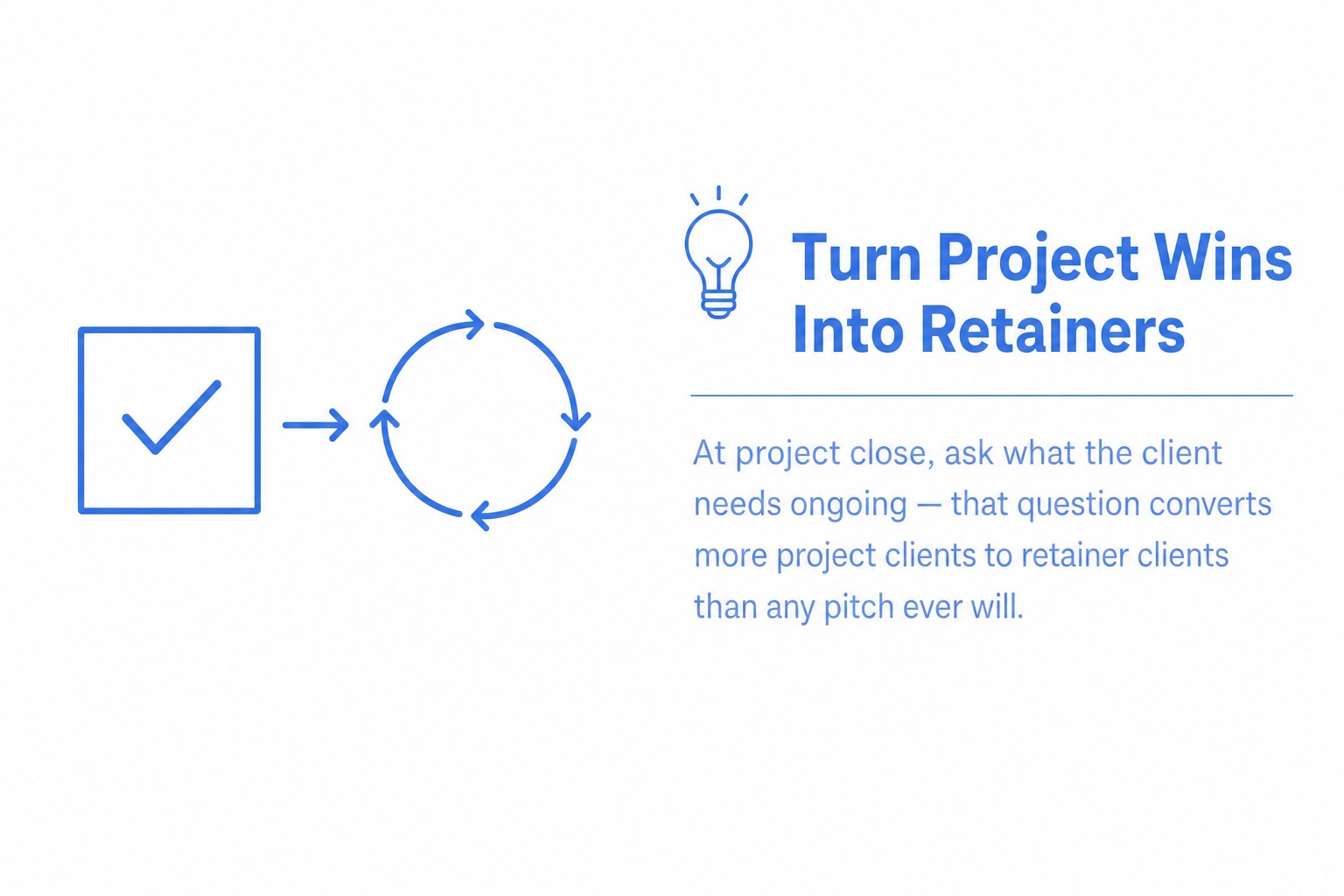 At project wrap-up, ask about ongoing needs—the simplest way to turn project success into a retainer.
Building a consulting practice that generates consistent income requires getting the model right before you build the pipeline around it. For a deeper look at how to structure your consulting fees and engagement terms, the consulting pricing frameworks guide covers the mechanics in detail.
The retainer vs project decision isn't permanent. Start with what serves the client and protects your margin. Revisit it every six months. The right model for this client today may not be the right model for them a year from now, and the best consulting relationships are the ones flexible enough to adapt.